
Pan-India Pilgrimage
The Bada Char Dham of India: Adi Shankaracharya’s Four Sacred Abodes
The Bada Char Dham (Great Four Abodes) is the pan-India pilgrimage circuit established by the 8th-century philosopher Adi Shankaracharya. Spanning Badrinath in the north, Dwarka in the west, Rameshwaram in the south and Jagannath Puri in the east, it binds the geographical extremes of the subcontinent into a single spiritual quadrilateral.
Adi Shankaracharya’s spiritual legacy and cultural unity
The Char Dham holds a paramount position on India’s cultural and spiritual map. More than just a group of four pilgrimage sites, it is a testament to the vision of Adi Shankaracharya, the 8th-century philosopher and reformer who sought to unify India’s diverse cultural and religious fabric into a single thread. Known as the Bada Char Dham (Great Four Abodes), these sites - Badrinath, Jagannath Puri, Rameshwaram and Dwarka - sit in the four corners of the Indian subcontinent, effectively turning its geographical boundaries into a sacred quadrilateral.
The primary purpose of establishing these shrines, and of visiting them, is the attainment of Moksha (salvation), the ultimate goal of liberation from the cycle of birth and death in Hindu philosophy. Adi Shankaracharya developed these sites not only as centres of worship but also as living institutions for the preservation of Vedic knowledge and tradition. From the Himalayan caves in the north to the shores of the Indian Ocean in the south, and from the Bay of Bengal in the east to the Arabian Sea in the west, this journey is considered one of the most significant spiritual achievements in a Hindu’s life.
Institutional foundation: the four Amnaya Peethas
To ensure the propagation of Sanatana Dharma and Advaita Vedanta, Adi Shankaracharya established four monasteries (Amnaya Peethas) in the four corners of the country. Each was entrusted with preserving a specific Veda, a Mahavakya (grand pronouncement) and a particular tradition. The structure remains intact today, with the heads of these monasteries carrying the title of Shankaracharya.
| Matha | Location | Direction | Veda | Mahavakya | First Acharya |
|---|---|---|---|---|---|
| Jyotirmath | Badrinath, Uttarakhand | North | Atharva Veda | Ayamatma Brahma | Sri Totakacharya |
| Govardhan Matha | Puri, Odisha | East | Rig Veda | Prajnanam Brahma | Sri Hastamalakacharya |
| Sringeri Sharada Peetham | Sringeri, Karnataka | South | Yajur Veda | Aham Brahmasmi | Sri Sureshwara |
| Kalika Matha (Dwarka Matha) | Dwarka, Gujarat | West | Sama Veda | Tattvamasi | Sri Padmapadacharya |
The underlying objective was to ensure that people in every corner of India remained connected to the core knowledge of the Vedas despite regional cultural differences. Kalika Matha in the west preserves the musical, chant-based worship of the Sama Veda, while Jyotirmath in the north serves as a centre for the philosophy and mysteries of the Atharva Veda.
Spiritual and geographical alignment of the yatra
The geographical alignment of the four abodes is remarkably precise. Badrinath in the north and Rameshwaram in the south lie on the same longitude, while Dwarka in the west and Puri in the east lie on approximately the same latitude. This configuration binds the vastness of India into a single spiritual perimeter. Tradition starts the sacred journey at Badrinath, followed by Dwarka in the west, Rameshwaram in the south, and finally Jagannath Puri in the east.
According to popular folklore, Lord Vishnu performs his daily activities across the four abodes: he bathes at Rameshwaram, meditates at Badrinath, dines at Puri and retires at Dwarka. The narrative not only highlights the uniqueness of each site but also fosters in the devotee a sense of participating in the daily life of the divine throughout the journey.
The North Dham: Badrinath - the land of meditation and knowledge
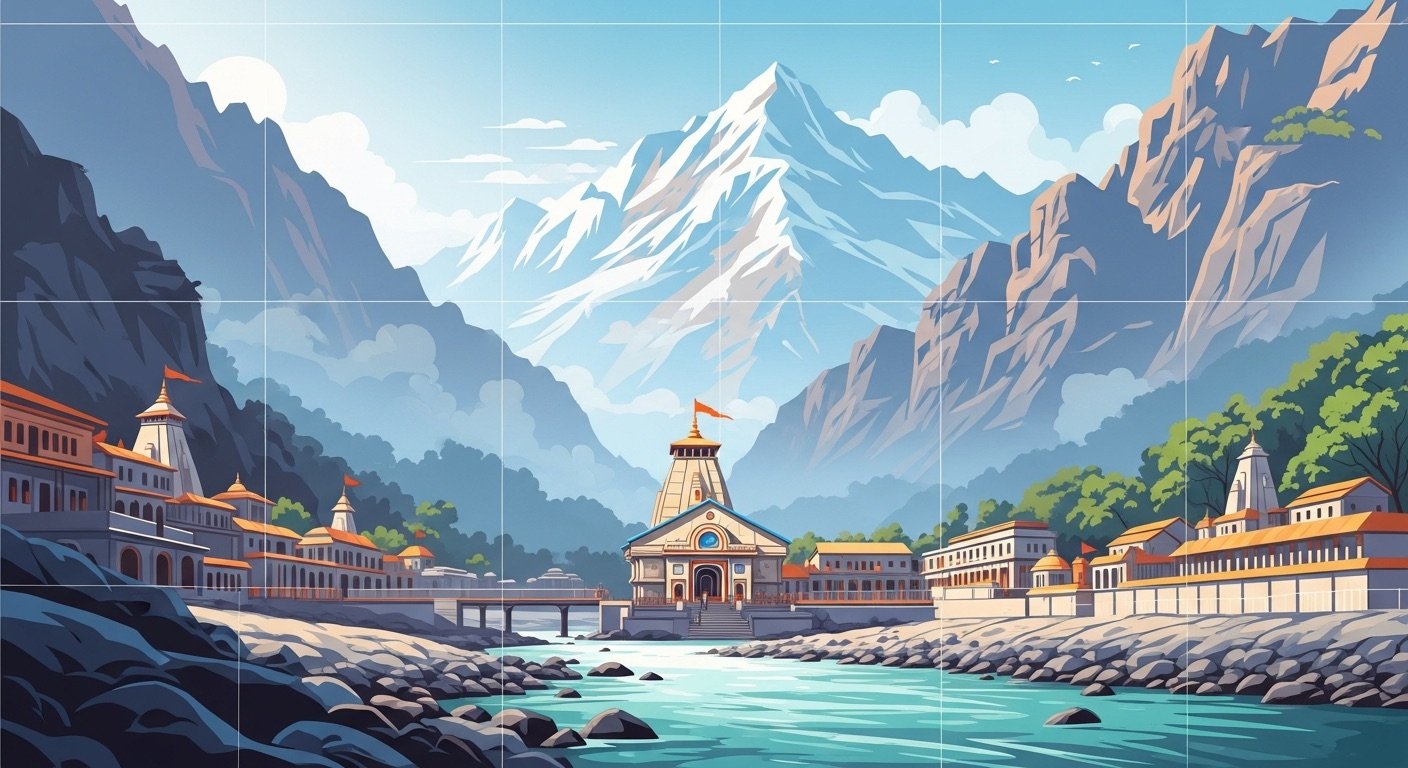
Badrinath Dham, also known as Vishal Badri, sits on the banks of the Alaknanda river in the Chamoli district of Uttarakhand at an altitude of 3,133 metres. It is nestled between the Nar and Narayan mountain ranges, under the shadow of the Nilkantha peak. For helicopter pilgrims, Badrinath is the only Bada Char Dham site that is also part of the Uttarakhand circuit - see our Badrinath Dham guide for the helicopter approach.
Mythological background and origin
The name Badrinath derives from the Badri (berry) tree. According to mythology, when Lord Vishnu was performing rigorous penance here, Goddess Lakshmi took the form of a Badri tree to protect him from the harsh snow and cold. Pleased by her devotion, the Lord declared that the place would be known by her name first, as Badri-Nath. Another belief states that this is where Vishnu incarnated as Nar and Narayan to perform penance for the welfare of humanity.
Architecture and temple features
The current structure of the Badrinath Temple is known for its vibrant colour scheme and gabled roof. The stone facade features arched windows, and a broad stairway leads to the main entrance, the Singh Dwara. The sanctum sanctorum houses a 1-foot tall black granite idol of Lord Vishnu in a meditative (Padmasana) pose, distinct from the more common reclining Vishnu form. It is considered one of the eight Svayam Vyakta Kshetras, sites where the idol is self-manifested.
Just below the temple is the Tapt Kund, a natural hot water spring. Water temperature stays around 55°C year-round, despite outside temperatures often near freezing. Pilgrims consider it mandatory to bathe in the holy water, which is believed to have medicinal properties, before entering the temple.
Seasonal cycle and winter abode
Due to extreme Himalayan weather and heavy snowfall, the Badrinath Temple remains open for only six months (April or May to October or November). The dates for closing and opening are fixed on Vijayadashami and Basant Panchami, respectively. For exact 2026 dates see our Char Dham temple timings page.
| Year | Pilgrims visiting Badrinath |
|---|---|
| 2019 | 1,242,546 |
| 2022 | 1,514,714 |
| 2023 | 1,834,729 |
| 2024 | 1,359,853 |
When the temple closes for winter, the Utsav Murti (ceremonial idol) of Lord Badri Vishal is shifted to the Narsimha Temple in Joshimath, where worship continues throughout the winter. It is believed that during the winter months, when humans cannot reach the temple, Sage Narada performs the daily rituals for the Lord.
The West Dham: Dwarka - the eternal kingdom of Krishna

Located on the western coast of Gujarat at the confluence of the Gomti river and the Arabian Sea, Dwarka is dedicated to Lord Krishna. The Dwarkadhish Temple, also called Jagat Mandir, is a site where history, mythology and modern marine archaeology converge.
Submerged Dwarka and archaeological findings
According to the Mahabharata, Dwarka was a magnificent city reclaimed from the sea by Krishna, which submerged after his departure from the mortal world. Research by the National Institute of Oceanography (NIO) between 1983 and 1992 revealed underwater remains of walls, pillars and ancient stones. Explorations at depths of 3 to 12 metres found stone anchors, pottery and evidence of ancient settlements dating back to roughly the 15th century BCE, strengthening the belief that Krishna’s legendary city lies beneath the waters near modern Dwarka.
Architecture of Jagat Mandir
The current Dwarkadhish Temple is a five-storey building supported by 72 carved pillars. The main spire (Shikhara) rises to 78 metres, upon which a 50-foot flag featuring sun and moon symbols is hoisted. The flag is changed five times a day, a significant event for devotees. The temple is built using limestone and sand in the Chalukya (Maru-Gurjara) style.
| Detail | Figure |
|---|---|
| Height of main spire | 78 metres (256 feet) |
| Number of pillars | 72 carved pillars |
| Architectural style | Maru-Gurjara / Chalukya |
| Major festival | Janmashtami (August / September) |
The nearby Bet Dwarka island is believed to be Krishna’s actual residence. The recently inaugurated Sudarshan Setu bridge now makes the island easily accessible for pilgrims.
The South Dham: Rameshwaram - the confluence of Shaiva and Vaishnava
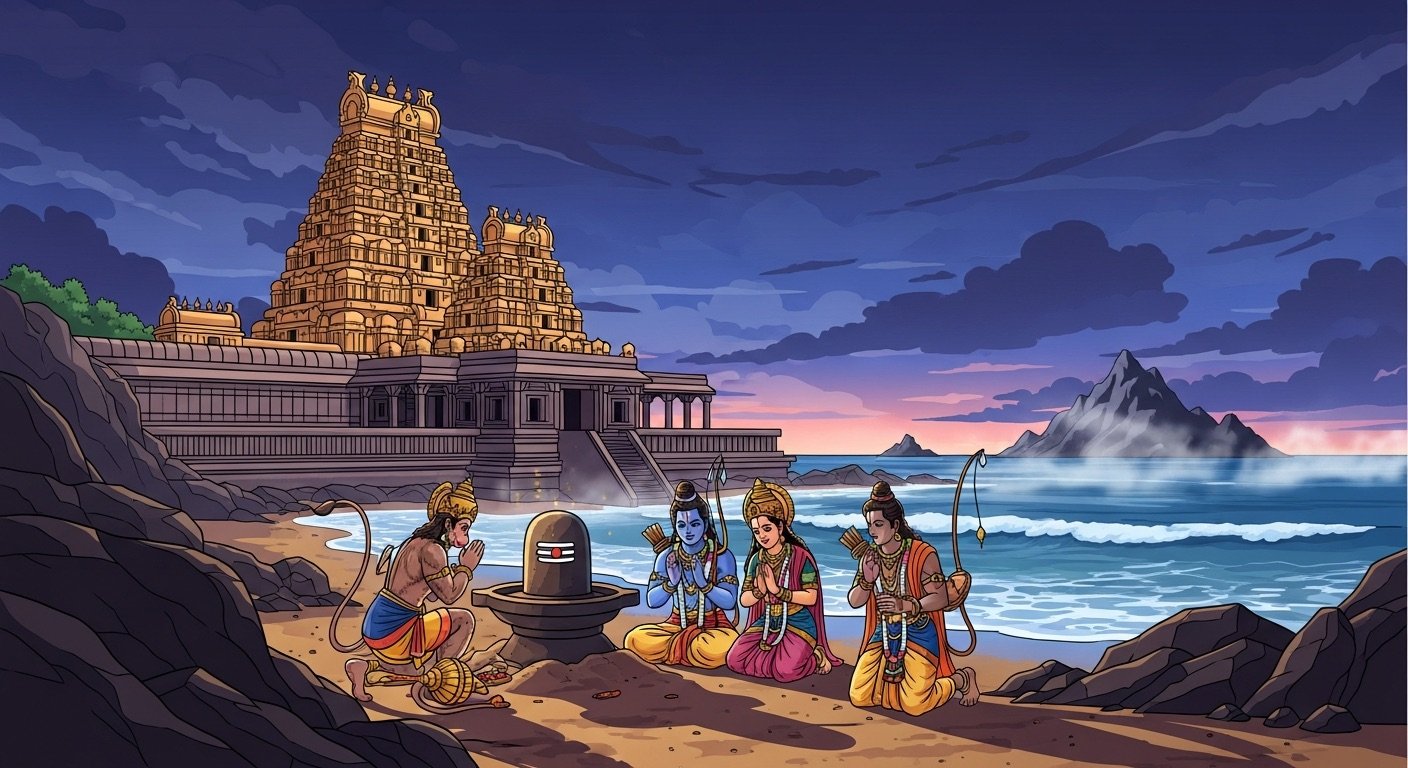
Located in Ramanathapuram district of Tamil Nadu, Rameshwaram is one of India’s most sacred sites. It is unique because it is both part of the Bada Char Dham and one of the twelve Jyotirlingas of Lord Shiva. The site marks the location where Lord Rama established a Shiva Linga, making it holy for both Vaishnavites and Shaivites.
Ramayana connection and legend
According to legend, after slaying Ravana, Lord Rama sought to atone for the sin of killing a Brahmin by worshipping Lord Shiva. Hanuman was sent to Mount Kailash to bring a Linga, but when he was delayed, Goddess Sita fashioned a Linga out of sea sand, known as Ramalingam. The Linga later brought by Hanuman was also installed nearby and is called Vishwalingam.
The world’s longest corridor
The Ramanathaswamy Temple is renowned for its massive corridors. The third corridor is considered the longest in the world, stretching approximately 1,212 metres. Each pillar is intricately carved, representing the pinnacle of Dravidian architectural excellence.
| Detail | Dimension |
|---|---|
| Total number of pillars | 1,212 carved pillars |
| Height of corridor | Approx. 30 feet floor to ceiling |
| Height of main Gopuram | 53 metres (Rajagopuram) |
| Temple area | Approx. 15 acres |
The 22 holy Teerthams (wells)
A pilgrimage to Rameshwaram is considered incomplete without bathing in the 22 holy wells (Teerthams) inside the temple complex. They are said to represent the 22 arrows in Lord Rama’s quiver.
- Mahalakshmi Teertham: the first well, believed to grant wealth and prosperity.
- Savitri, Gayatri and Saraswati Teerthams: believed to provide relief from ailments and curses.
- Brahmahatya Vimochana Teertham: one of the most important wells, believed to absolve the gravest sins.
- Ganga, Yamuna and Gaya Teerthams: named after north India’s holy rivers and associated with wisdom.
The East Dham: Jagannath Puri - the abode of the Lord of the Universe
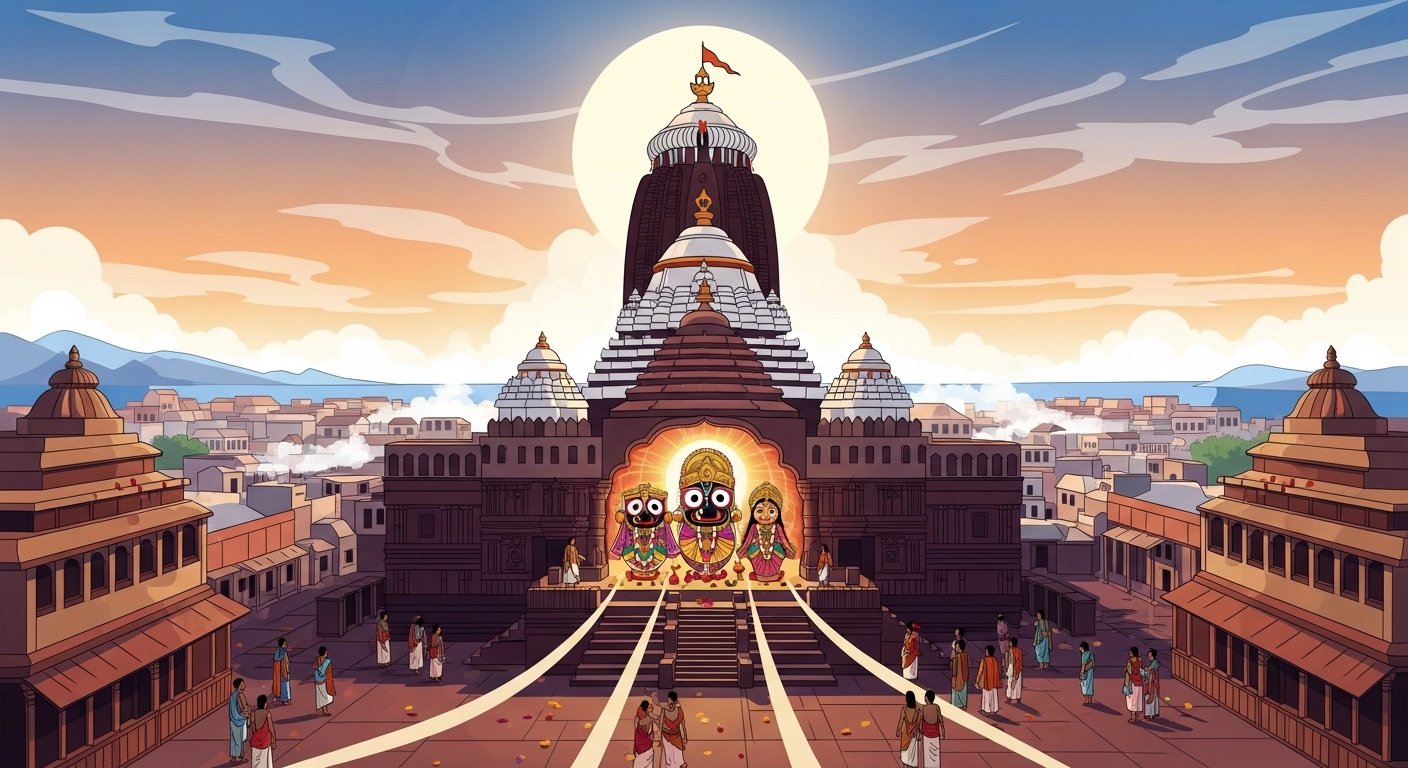
Situated in the coastal city of Puri, Odisha, the Jagannath Temple is the eastern abode. It is dedicated to Jagannath (a form of Krishna), his brother Balabhadra and his sister Subhadra. The city is also known as Sri Kshetra and its traditions are ancient and deeply mystical.
Unsolved mysteries of the temple
Several phenomena associated with the Puri temple continue to baffle both scientists and devotees.
- The reverse flag: the flag atop the temple always flutters in the opposite direction of the wind. Some attribute it to complex aerodynamics (Karman Vortex Street); for many it remains a divine mystery.
- The missing shadow: the main dome is said to never cast a shadow on the ground at any time of the day, considered a feat of ancient engineering.
- Silence of the sea: upon entering the Singh Dwara (Lion Gate), the sound of the ocean waves disappears, only to be heard again once you step outside.
- No-fly zone: neither birds nor planes are seen flying over the temple spire.
Mahaprasad and the world’s largest kitchen
The temple kitchen is the largest in the world, feeding thousands of devotees daily. The cooking method is unique: seven clay pots are stacked on top of each other and the food in the topmost pot always cooks first. It is claimed that the Mahaprasad never runs short, regardless of the number of pilgrims.
Rath Yatra and Nabakalebara
The annual Rath Yatra is world famous, with the deities travelling in massive chariots to the Gundicha Temple. Another significant ritual is Nabakalebara, performed every 8 to 19 years, where the old wooden idols are replaced with new ones carved from sacred neem trees, symbolising the Hindu concept of reincarnation.
Comparative statistics and modern challenges
In modern times the Char Dham journey is not just a religious act but a pillar of India’s tourism economy. This brings ecological challenges. In cities like Puri, tourism accounts for nearly 80% of the local economy, and Gujarat has seen record-breaking crowds in recent years.
| Site / Event | Annual or special-occasion pilgrim count |
|---|---|
| Badrinath (2023) | 1,834,729 |
| Jagannath Puri (New Year 2024) | 500,000+ in a single day |
| Dwarka (during Holi) | 500,000+ |
| Uttarakhand Char Dham total (2025) | 5,106,346 |
To manage the crowds, the government has introduced measures such as the Registration and Tourist Care portal for Uttarakhand and improved transport services. A recent analysis revealed that 72% of pilgrims arrive within the first 60 days of the season, putting immense pressure on fragile infrastructure. Maintaining ecological balance in the Himalayas remains a priority, with authorities considering mandatory fees and stricter crowd-control measures. Pilgrims planning the Uttarakhand leg can avoid road bottlenecks with our helicopter packages.
Cultural integrity and spiritual consciousness
The Bada Char Dham of India is more than a set of temples in stone and mortar; it is the soul of a nation. Through these sites, Adi Shankaracharya provided a thread of unity that transcends linguistic, regional and ethnic boundaries. The meditation of Badrinath, the dharma of Dwarka, the atonement of Rameshwaram and the devotion of Puri together complete the circle of Hindu philosophy. As India moves toward modernity, these abodes keep the nation anchored to its spiritual roots and diverse heritage.