
Known and Unheard
Shiva Circuits of India
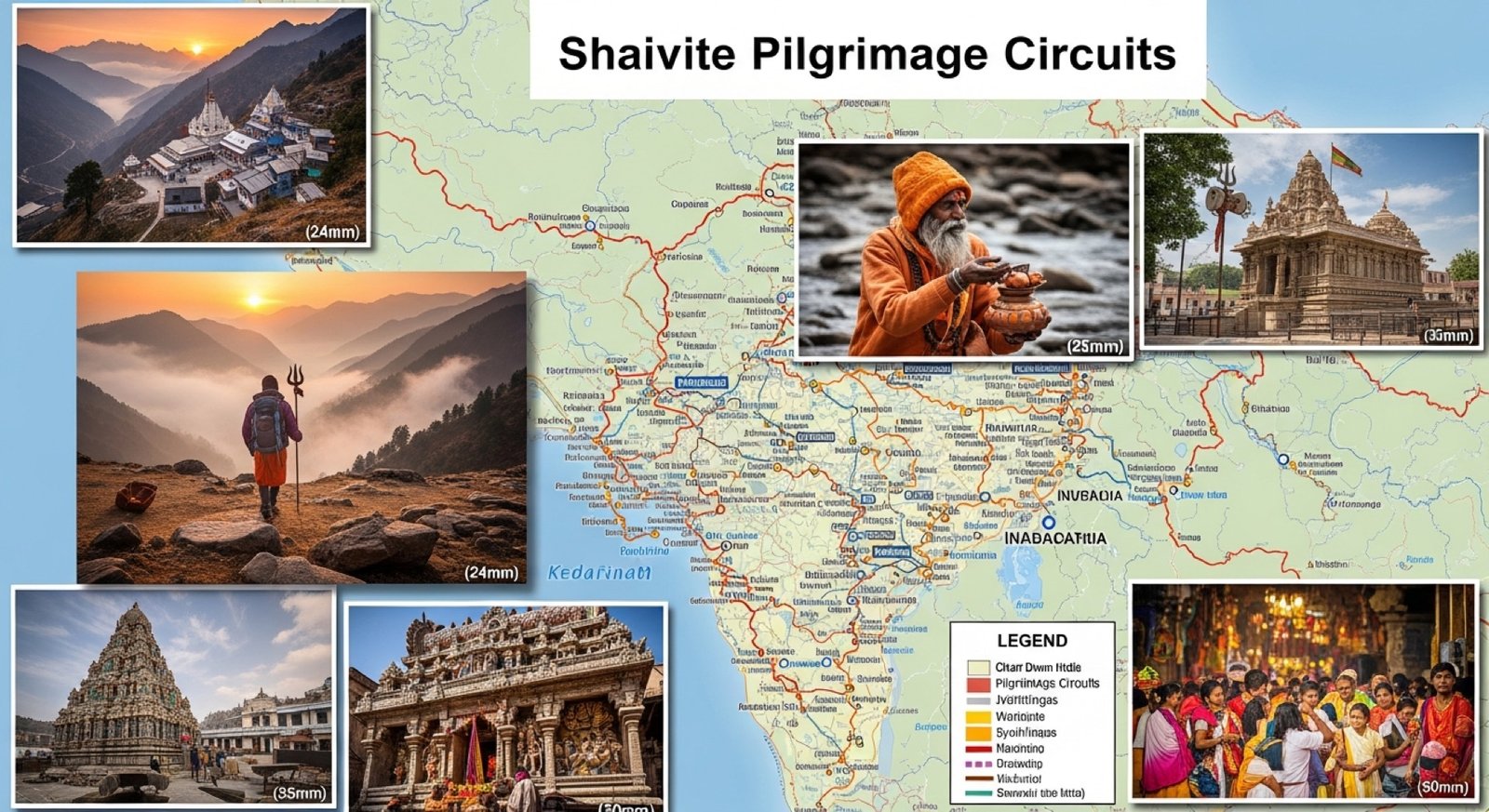
Shaivism is not a single doctrine but a spatial organisation of metaphysical ideas. From the 12 Jyotirlingas of Puranic fame to the lightning-struck lingam of Bijli Mahadev, the submerged riverbed of Sahasralinga, and the Hindu-Buddhist shared sanctum at Triloknath - this is the master map of how India has located the divine across two millennia of sacred geography.
01 · The Twelve Jyotirlingas
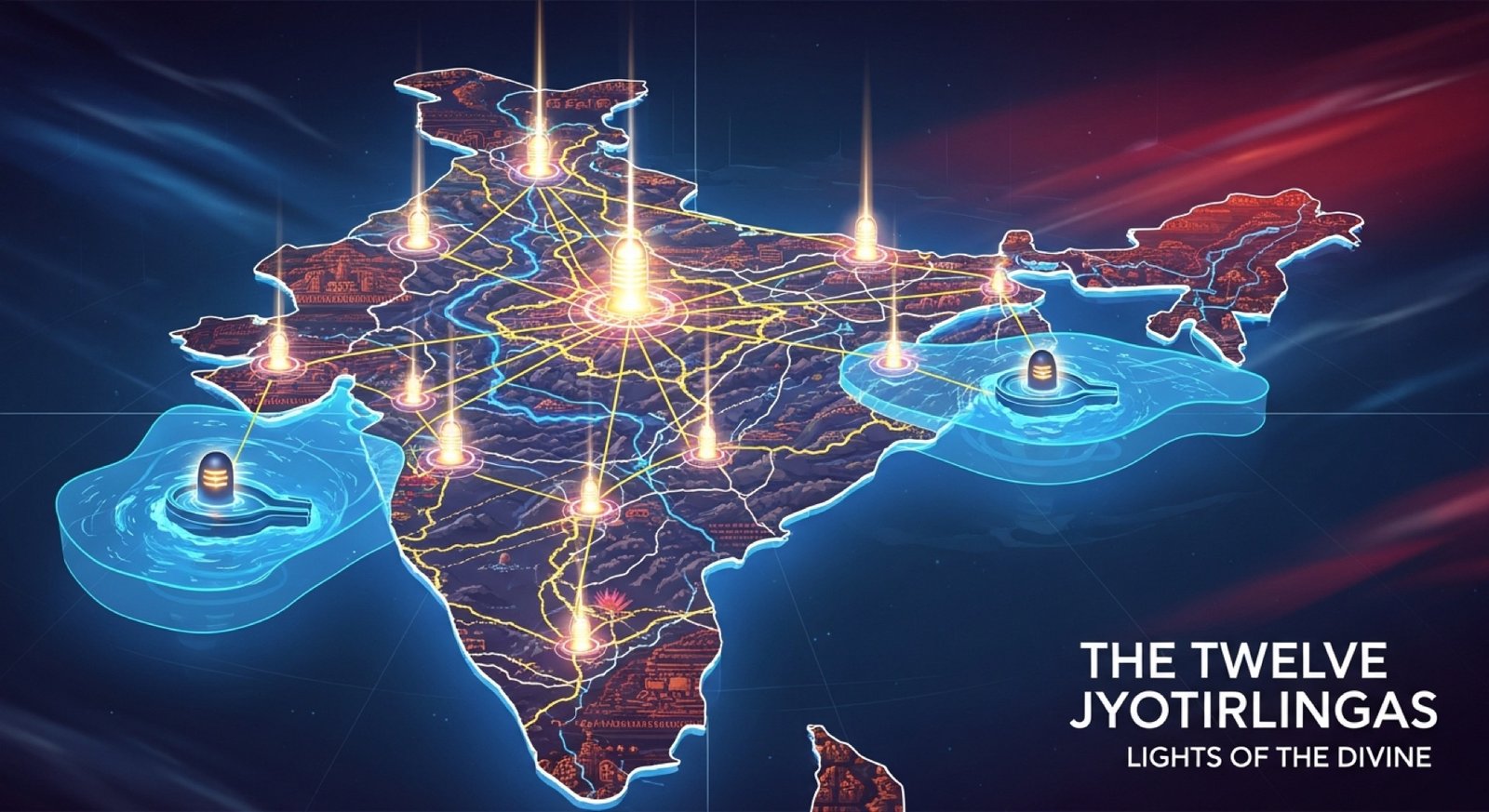
The most foundational Shaivite circuit. Twelve Swayambhu (self-manifested) lingams where Shiva appeared as a pillar of light to settle the cosmic hierarchy between Brahma and Vishnu. The distribution spans the subcontinent - and unifies disparate linguistic and cultural zones under a single sacred geometry.
| Jyotirlinga | Location | State | Form | Note |
|---|---|---|---|---|
| Somnath | Prabhas Patan | Gujarat | Lord of the Moon | Mentioned in the Rigveda; rebuilt multiple times after invasions - a symbol of national resilience. |
| Mallikarjuna | Srisailam | Andhra Pradesh | Lord of Mountains | Unique: both a Jyotirlinga and a Shakti Peetha. |
| Mahakaleshwar | Ujjain | Madhya Pradesh | Lord of Time | The only south-facing (Dakshin Mukhi) Jyotirlinga; famous Bhasma Aarti ritual. |
| Omkareshwar | Mandhata Island | Madhya Pradesh | Lord of the Om Sound | The island is naturally shaped like the "Om" symbol. |
| Kedarnath | Rudraprayag | Uttarakhand | Lord of the Field | The highest Jyotirlinga; Pandava redemption legend. See /destinations/kedarnath-temple/. |
| Bhimashankar | Khed | Maharashtra | The Fierce Lord | Victory over the demon Tripurasura; source of the Bhima river. |
| Kashi Vishwanath | Varanasi | Uttar Pradesh | Lord of the Universe | The spiritual heart of India. The Tarak Mantra is said to be whispered into the dying. |
| Trimbakeshwar | Nashik | Maharashtra | The Three-Eyed Lord | Source of the Godavari river; lingam has three facets representing the Trinity. |
| Vaidyanath | Deoghar | Jharkhand | Lord of Healers | Associated with Ravana's penance; Shiva in his medicinal aspect. |
| Nageshwar | Dwarka | Gujarat | Lord of Serpents | Protection from poison and malevolent forces. |
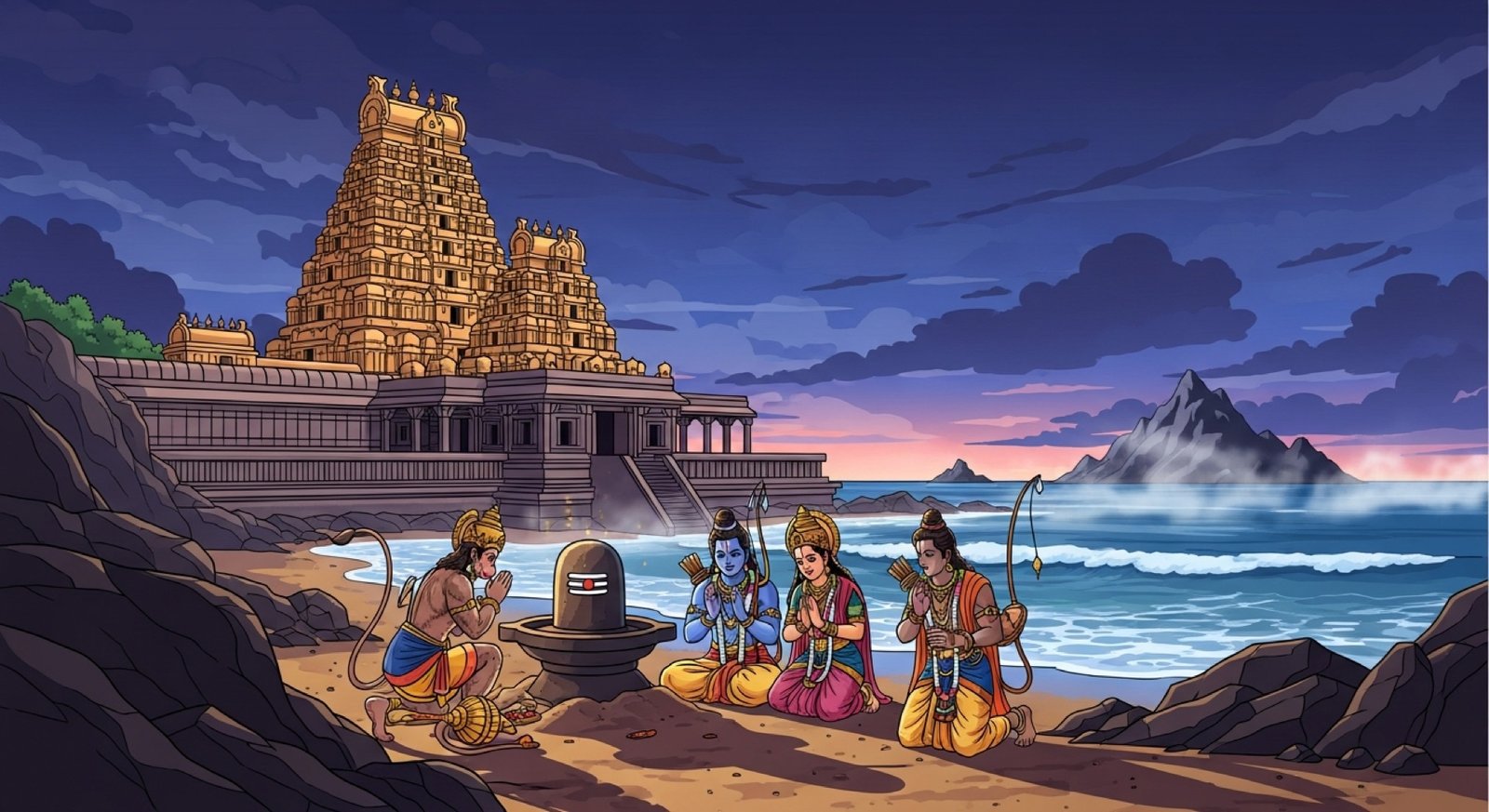
| Rameshwaram | Rameswaram | Tamil Nadu | Lord of Rama | Installed by Lord Rama en route to Lanka; connects to the Ram Setu. |
| Grishneshwar | Aurangabad | Maharashtra | Lord of Compassion | The smallest Jyotirlinga; located near the UNESCO Ellora Caves. |
Each carries a distinct theological weight. Somnath: resilience - rebuilt after every invasion. Mahakaleshwar: mastery over time and death, marked daily by the Bhasma Aarti. Omkareshwar: the geography itself speaks, the island naturally shaped like Om. Kashi Vishwanath: the whispered Tarak Mantra into the ear of the dying, said to grant moksha. Kedarnath is the highest Jyotirlinga and the crown of the Himalayan circuit.
02 · Panch Kedar - Shiva's Fragmented Body
After the Mahabharata, the Pandavas sought Shiva to atone for the sins of Gotra Hatya (fratricide) and Brahmana Hatya (killing teachers). Shiva, unwilling to grant absolution, took the form of a bull and fled into the Garhwal Himalayas. When Bhima confronted him at Guptakashi, the bull dove into the earth. Its body parts reappeared at five sites - each now a temple - mapping Shiva's fragmented form across the mountains.
| Temple | Body Part | Altitude | Trek |
|---|---|---|---|
| Kedarnath | Hump of the bull | 3,583m | 18 km - challenging |
| Tungnath | Arms (Bahu) | 3,680m | 3.5 km - moderate (highest Shiva temple in the world) |
| Rudranath | Face (Mukh) | 3,559m | 20 km - very high |
| Madhyamaheshwar | Navel and stomach | 3,490m | 24 km - high |
| Kalpeshwar | Matted hair (Jata) | 2,200m | Road access - year-round |
Traditional pilgrimage closes not at the fifth Kedar but at Badrinath - the seat of Vishnu - as a witness to the Pandavas' completed penance. Full destination guides: Panch Kedar circuit, Tungnath, Rudranath, Madhyamaheshwar, Kalpeshwar.
03 · Panch Bhoota Stalam - The Five Elements
Five South Indian temples, each anchoring one of the five maha-bhootas: Earth, Water, Fire, Air, Space. Located primarily in Tamil Nadu with one outlier in Andhra Pradesh - four sit on nearly the same longitude, a feat of ancient geography.
The architectural brilliance belongs to the Chola, Pallava, and Vijayanagara dynasties. Each temple encodes its element physically: a sand lingam at Ekambareswarar, an underground spring at Jambukeswarar, an entire hill at Arunachaleswarar, a flickering windless lamp at Srikalahasti, and an empty space behind a curtain at Chidambaram (the Akasha Lingam, the Chidambara Rahasyam).
Read the full Pancha Bhoota Stalam guide →
To do the circuit in one arranged trip, see the 5N/6D Pancha Bhoota + Tirupati package - all five elemental shrines, Meenakshi, and Tirumala VIP Darshan with private transport.

04 · Panch Kailash - The Five Himalayan Peaks
Five Himalayan peaks revered as the literal abodes of Shiva. Mount Kailash in Tibet is the spiritual core and "centre of the universe" for Hindus, Buddhists, Jains, and Bon followers. The remaining four lie within Indian borders and serve as equally sacred alternatives for pilgrims unable to cross the international border.
| Peak | Location | Altitude | Unique feature | Spiritual archetype |
|---|---|---|---|---|
| Mount Kailash | Ngari, Tibet | 6,638m | The 52 km high-altitude parikrama | Formless, Eternal Divine |
| Adi Kailash | Uttarakhand | 6,191m | Mirror image of the Tibetan peak | The Divine Family Man |
| Kinnaur Kailash | Kinnaur, Himachal | 6,050m | 79-foot rock pillar that changes colour through the day | The Cosmic Dancer |
| Mani Mahesh | Chamba, Himachal | 5,653m | Glacial lake at 4,080m reflects the peak | The Merciful Protector |
| Shrikhand Mahadev | Kullu, Himachal | 5,227m | 75-foot vertical rock lingam; hardest Himalayan trek | The Ascetic Yogi |
The Shrikhand Mahadev trek is widely considered the hardest pilgrimage trek in India - more demanding than Amarnath. The Mani Mahesh Yatra centres on a glacial lake at 4,080 m; legend says only those with a pure heart see the peak's reflection clearly. Mount Kailash itself is never climbed - the parikrama circles the mountain without ever touching the summit. See Mount Kailash destination guide.
05 · The Shiv-Shakti Circuit
The masculine principle (Shiva) and the feminine energy (Shakti) are physically paired across the Himalayan foothills of Himachal Pradesh and the hills of Nepal. Pilgrimage here is dualistic - one visits the Jyotirlingas and the adjacent Shakti Peethas (sites where the body parts of Goddess Sati fell after her self-immolation) as a single sacred circuit.
The Himachal Dev Bhoomi
- Naina Devi - perched above Govind Sagar Lake, where the Goddess's eyes (nayan) fell. Symbolises vision and the removal of ignorance.
- Jwalamukhi - worshipped not as an idol but as nine eternal natural flames emerging from the rock, a geological signature of the element.
- Chintpurni (Mata Chhinnamastika) - believed to "remove all worries" instantly.
- Chamunda Devi - the fourth major Himachal Peetha, completing the classical circuit.
Pashupatinath (Nepal)
In Nepal, Pashupatinath serves as the Aradhya Dev (ruling deity) of the country. It is spiritually linked to the nearby Guheyshwori Shakti Peetha, completing the dualistic worship of the divine couple on a trans-national scale.
06 · The Unheard Shaivite Circuits
Beyond the famous yatras lie sites that challenge the conventional Puranic narrative. These are the engineering marvels, the riverine devotions, the lightning-struck shrines, the Hindu-Buddhist syncretic sanctums, and the unfinished monuments of kings. Most pilgrims never reach them - which is precisely why they preserve the full experimental reach of Shaivism.
| Site | Location | Phenomenon | Attribution |
|---|---|---|---|
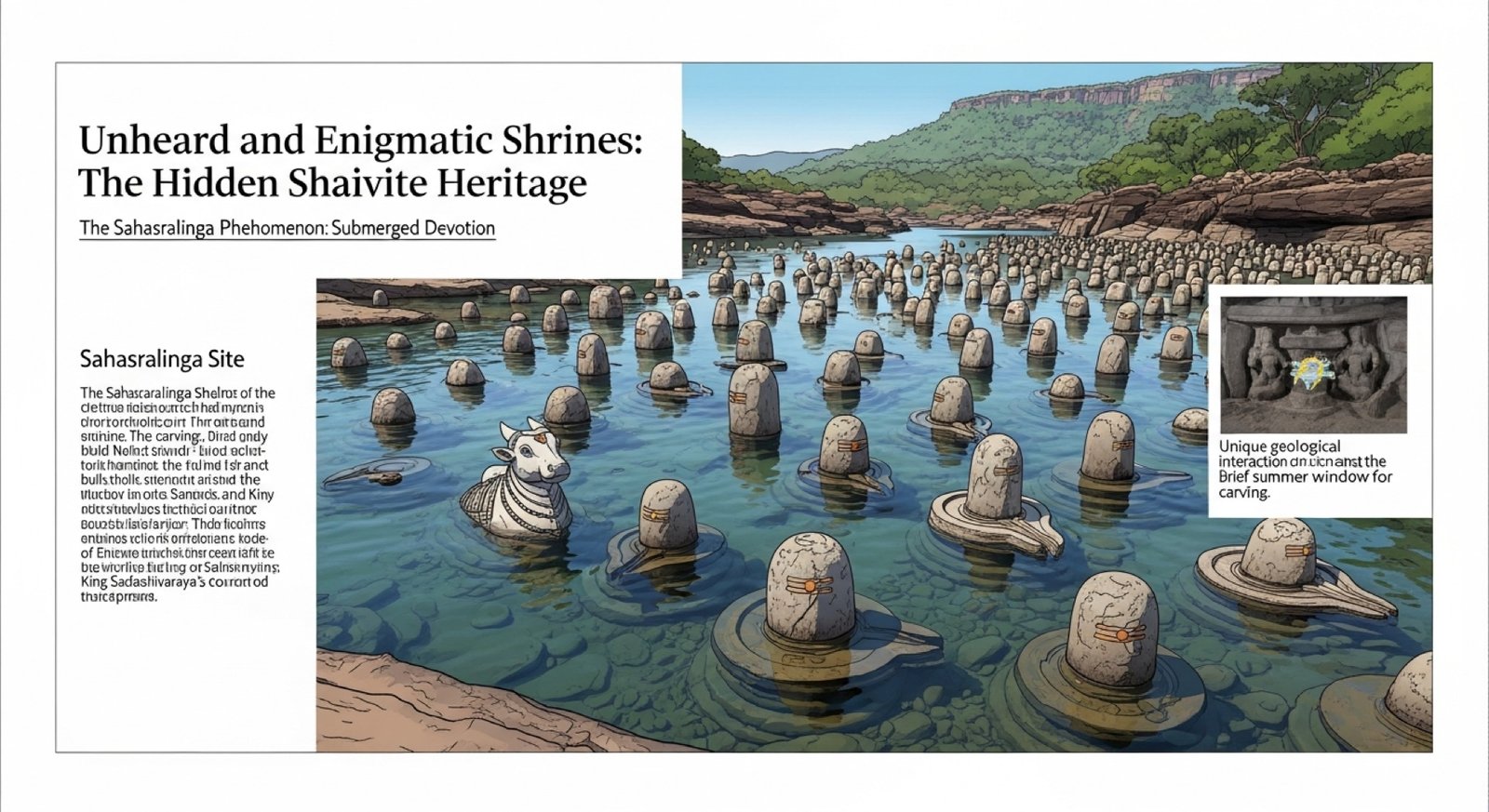
| Sahasralinga | Sirsi, Karnataka | 1,000 lingams carved into the Shalmala riverbed - visible only when the river recedes in summer | King Sadashivaraya (17th c.) |
| Unakoti | Kailashahar, Tripura | Colossal rock-cut reliefs: "one short of a crore" stone gods. 30-foot central Shiva head (Unakotiswara Kal Bhairava) | 7th-9th c. CE (pre-Manikya) |
| Bijli Mahadev | Kullu Valley, Himachal | A 60-foot deodar staff attracts lightning; priests restore the shattered lingam with butter-and-pulse paste (Dev Vidhi) | Pandava legend; ancient Pahari tradition |
| Triloknath | Lahaul, Himachal | Hindu-Buddhist syncretic shrine - worshipped as Shiva AND Arya Avalokiteshvara in the same sanctum | Davanjara Rana (10th c.) |
| Masrur | Kangra, Himachal | Monolithic rock-cut temple cluster in early Nagara style | Early 8th c. CE |
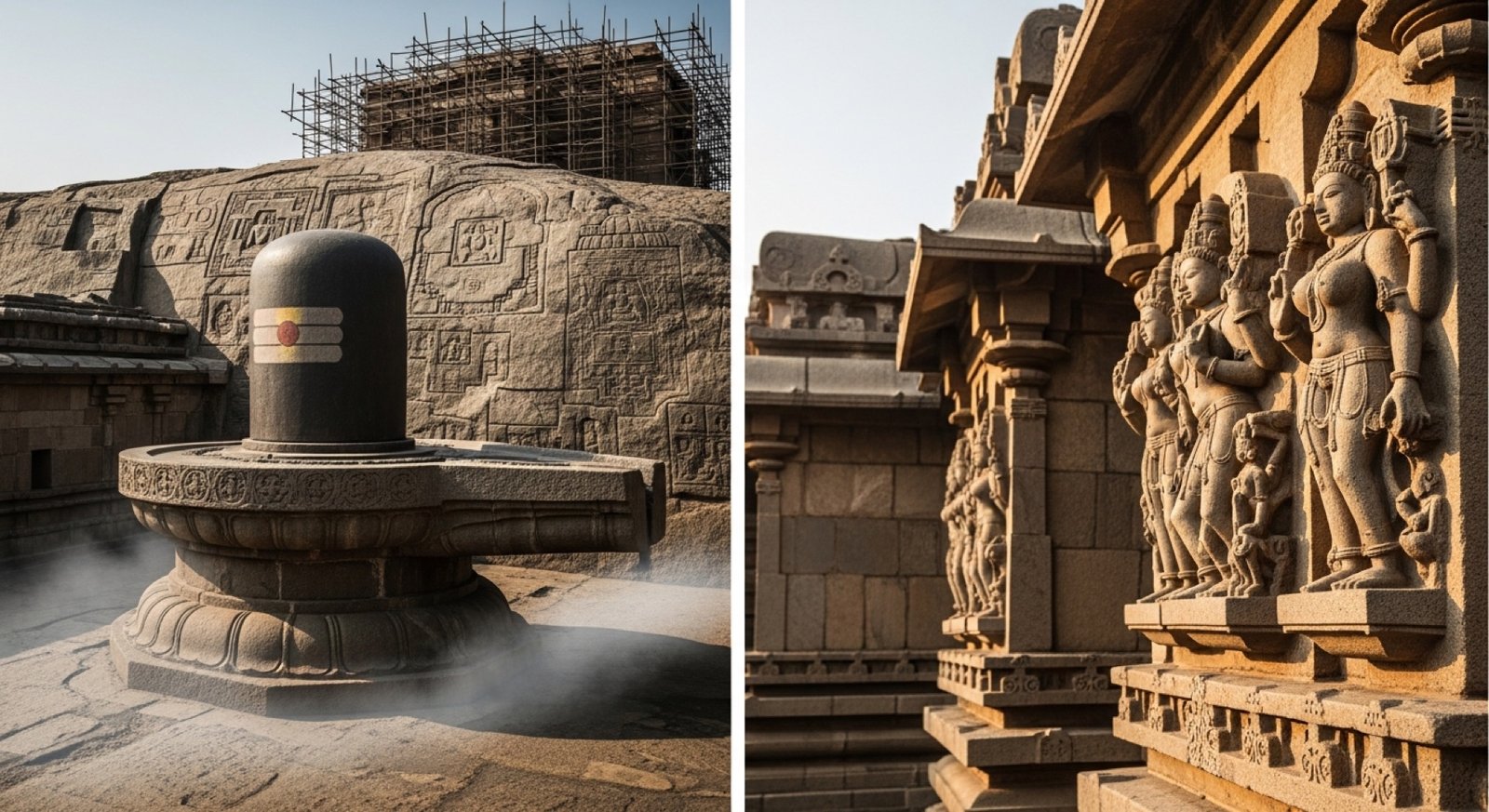
| Bhojpur | Bhopal, Madhya Pradesh | Unfinished 26-foot monolithic lingam; original architectural drawings etched into the surrounding rock | King Bhoja (11th c.) |
Sahasralinga and a trans-continental echo
Near Sirsi in Karnataka's Western Ghats, exactly 1,000 Shiva lingams are carved directly into the rocks of the Shalmala riverbed - each with its own Nandi bull. Commissioned by King Sadashivaraya (1678-1718), the sculptors could only work during the brief summer window when the river receded. And here is the mystery: over 2,500 miles away at Kbal Spean near Angkor Wat (Cambodia), a nearly identical "River of a Thousand Lingas" exists, carved in the 11th century to "fertilise" the water flowing down to the paddy fields. Two riverine lingam sites, separated by a subcontinent and several centuries, implying a shared belief in Shiva's creative energy transmitted through flowing water.
Unakoti - one short of a crore
In Kailashahar, Tripura, the Northeast preserves its own Shaivite inheritance. Unakoti means "one short of a crore" (9,999,999). Rock-cut reliefs of gods and goddesses cover the hillside - the central head of Shiva as Unakotiswara Kal Bhairava stands 30 feet tall, its embroidered head-dress alone measuring 10 feet. Legend: Shiva was travelling to Kashi with a crore of gods; he instructed them to wake before sunrise; when none did, he cursed them all to turn to stone. Folk tradition credits a sculptor named Kallu Gurjar, who attempted to carve a crore of idols in a single night and fell one short as dawn broke.
Bijli Mahadev - lightning and restoration
At 2,460 m in the Kullu Valley, a 60-foot deodar staff draws lightning to the temple every few years. The strike shatters the stone lingam inside the sanctum. The priests then restore the lingam using a paste of butter, cereals, and pulse flour - a ritual known as Dev Vidhi. The cycle of destruction and restoration is read as a divine metaphor for the cycle of life and death. The deity is understood to absorb negative energy that would otherwise harm the valley.
Triloknath - the syncretic sanctum
In Lahaul, Himachal, the Triloknath Temple is the only temple in the world where Hindus and Buddhists pay reverence to the same deity within the same sanctum. The six-armed white marble figure, seated in lalitasana with a small image of Amitabha Buddha at the crown, is revered as Shiva by Hindus and as Arya Avalokiteshvara (the Bodhisattva of Compassion) by Buddhists. The temple is managed by a joint Hindu-Buddhist committee; the annual Pauri Festival involves rituals from both traditions.
Bhojpur - the unfinished dream of a king
Near Bhopal, Madhya Pradesh, King Bhoja in the 11th century commissioned what would have been one of the largest Hindu temples ever built. Construction was abandoned - but the site remains critical. The original architectural drawings - plans for the shikhara, pillars, and lintels - remain engraved on the surrounding rock surfaces. The temple currently houses an 18-foot monolithic lingam on an 8-foot pedestal, dominating the landscape like the ghost of an ambition that never finished.
07 · Bhubaneswar - the Ekamra Kshetra
Bhubaneswar in Odisha is historically called Mandira Malini (The City of Temples). Between the 7th and 12th centuries it became a concentrated Shaivite circuit in its own right - a single city that traces the entire evolution of Kalinga temple architecture.
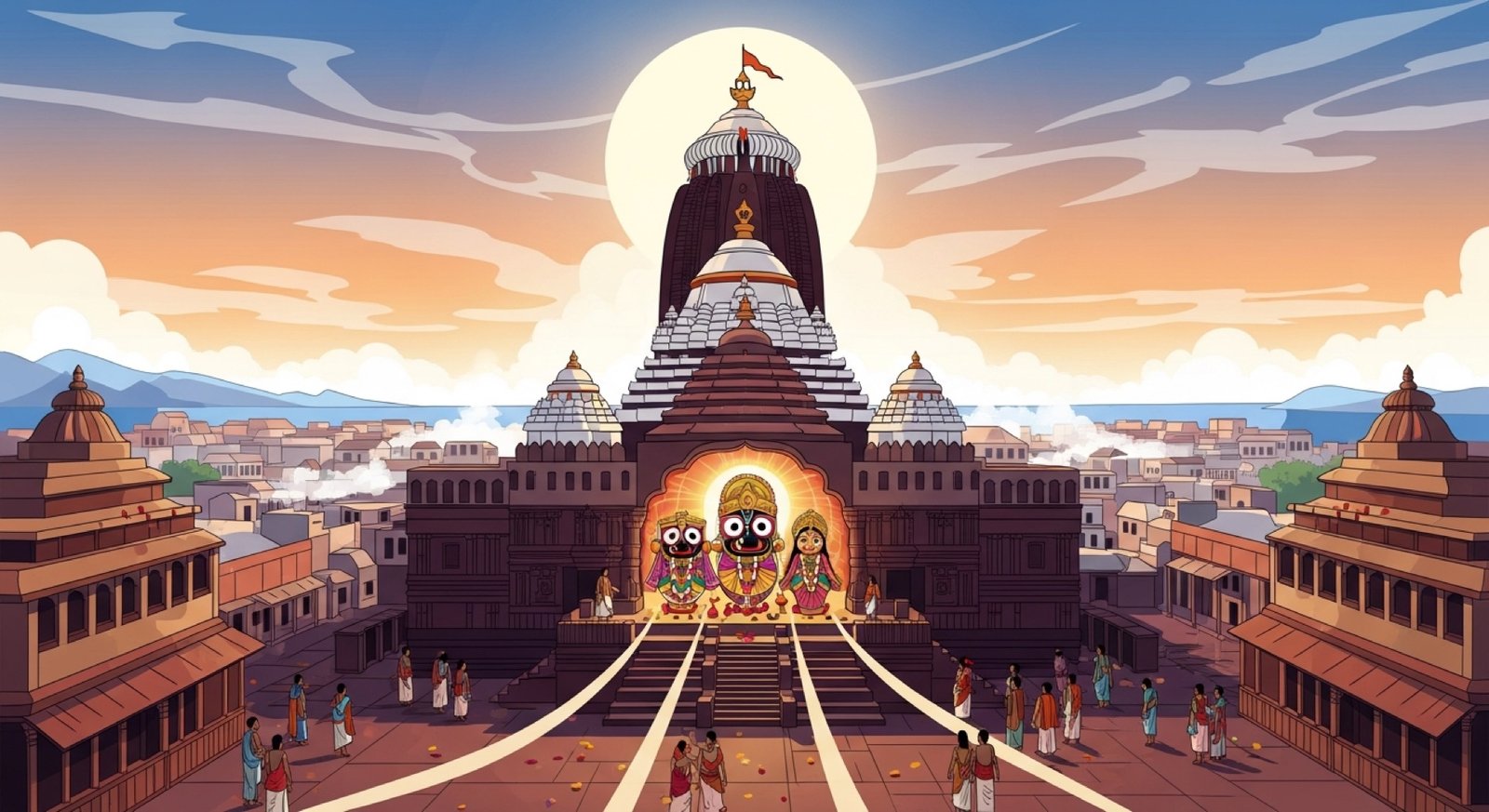
The Lingaraj Temple is the zenith - 180 ft tall, the quintessential Kalinga style, and a unique Hari-Hara synthesis (Shiva-Hara + Vishnu-Hari) that reflects the rise of the Jagannath cult under the Ganga dynasty.
| Temple | Century | Style | Feature |
|---|---|---|---|
| Parasurameswara | 7th c. | Early Kalinga | Reliefs of the Saptamatrikas. |
| Mukteswar | 10th c. | Mature Kalinga | Arched Torana with Buddhist influence - the "Gem of Odisha Architecture." |
| Lingaraj | 11th c. | Late Kalinga | 180 ft tall, Hari-Hara (Shiva-Vishnu) synthesis; four-part axial alignment. |
| Bhaskareswar | 13th c. | Unusual | Chariot-style architecture with a 9-foot lingam. |
Also in the region: Bhoramdeo in Chhattisgarh, "the Khajuraho of Chhattisgarh", built by the Naga dynasty (7th-12th c.). Its exterior walls carry erotic sculptures reflecting Tantric influences. The complex is named after the Gond tribal god Bhoramdeo, later identified with Shiva - a working example of how local tribal worship was integrated into the broader Shaivite fold.

Cultural synthesis - why the circuits matter
Read together, the Shaivite circuits are not a list of temples. They are a spatial organisation of metaphysical ideas. The Himalayan circuits (Panch Kedar, Panch Kailash) emphasise ascetic transformation through altitude and solitude. The South Indian circuit (Panch Bhoota Stalam) grounds cosmic balance in the five elements and integrates the arts - Chidambaram, after all, is a temple of dance. The "unheard" circuits - Sahasralinga, Unakoti, Bhojpur - reveal a Shaivism more experimental and geographically extensive than the standard Puranic narrative admits, often merging with state-building, tribal identities, or cross-cultural exchange.
The resilience is the point. Somnath has been physically rebuilt after each destruction. Bijli Mahadev's lingam is ritually rebuilt each time lightning shatters it. These are not monuments; they are living conduits of faith, bridging ancient mythology and contemporary practice. As cloudbursts in Himachal and urban encroachment in Bhubaneswar threaten these fragile landscapes, the traditional focus on sacred purity becomes a modern mandate for heritage conservation.
How Saffron Chariot plans a Shaiva yatra
The Char Dham helicopter circuit already covers Kedarnath (the highest Jyotirlinga) and Badrinath (the concluding witness of the Panch Kedar). From Dehradun, Panch Kedar trekking extensions are available for committed pilgrims. The Panch Bhoota Stalam is a separate winter yatra; we route through Chennai or Tirupati. And for those pursuing Mount Kailash, we coordinate with approved Nepal or Tibet operators - see the Kailash destination guide for seasons and routes.